Pages

Monday, February 27, 2017

Brazilian Hospitality

Bom Dia! Como você está?

You won't be able to read that if you don't understand Portuguese. Neither do Mindy or I. This posed quote the challenge for us as we spent the day on a Portuguese-language tour to see the Chilean cities of Valparaiso and Vina del Mar.

No,this wasn't our idea of an adventure, immersing ourselves in order to start learning the language and enjoy the beauty of Brazilian culture. Rather, I had been explicitly clear with the tour operator on Saturday evening when he called me at the hotel to let me know they didn't have space on the English-language tour on Sunday for Mindy and me (that we had already booked). 

"Can you take a Spanish-language tour tomorrow?" he asked hopefully; "otherwise we will have to refund you your money".  

"Neither my wife nor I speak Spanish", I replied, "so we wouldn't gain anything from such a tour. Do you have availability on the English-language tour on Monday? We can change our plans and do that, instead."

"Yes, we can put you on the Monday tour."

Excellent! The tour itinerary looked pretty stellar: two wineries, the twin coastal cities of Valparaiso and Vina del Mar, and a lunch at a high-end restaurant. We were excited that timing had worked out, and with the impromptu run with Team Mora yesterday, it really seemed that everything had lined up perfectly. 

Mindy first noticed that the tour driver who picked us up in the morning seemed to have a weak (VERY weak) handle on English, but she theorized that we would be joining another English group. Or maybe the guides were at each destination? Optimistic thinking, as it turned out. When the driver said something to us in Portuguese, then stared uncomfortably at us as we stared uncomprehending back at him, one of the other participants on the tour translated to English for us and told us that they were all Brazilians on this tour, including the driver. Um.....??!!

From that point, the guides explanations were translated (more or less) through a combination of the imperfect English among some of the participants on the tour, as well as a translation app on one very kind woman's cell phone. At one point, the guide spoke at length as we were driving, gesturing first to one side and then the other. When he finished, a very kind woman on the tour told "They used to mine silver here, but now the mines are closed." It was not the best way to absorb the details of the region, let alone ask questions. 
Mindy and I felt very out of place.

Tours are about more than the words, though, and the language barrier didn't prevent us from enjoying the stunning setting of Emiliana biodynamic winery in the Casablanca Valley.


The alpacas fertilize the soil and eat the leaves, exposing the grapes to more sun (to make them sweeter). Southbrook biodynamic winery in Niagara on the Lake uses sheep for the same purpose. (Of course, they are also aa good tourist attraction at Emiliana.)


If only I could taste everything!


Stunning! And so is the winery building!


We didn't learn until several days later that an overflowing handful of grapes is all that is required to make a bottle of wine...


(In Mindy's defense, our tour guide brought several handfuls into the car for us to eat, so the precedence was set.)

The next winery.....was generally forgettable, including the name. Kind of a tourist-trap shop selling all kinds of stuff. The good part was that they continuously replenished the long line of tasting glasses set up at the bar, and one could ("theoretically") go back several times. We never learned anything about the wine, so it wasn't your classic tasting, but it was tasty!


As we entered Valparaiso, we saw a reminder that Chile is on the "ring of fire" - more or less the circumference of the Pacific Ocean, where earthquakes are common.


Pablo Neruda's house was next; or one of his four recognized houses, anyway. Pablo Neruda was a poet, possibly a painter, and probably a politician. (So it goes when the tour is conducted in another language.) This house, now converted into a museum, is closed on Mondays, so we crowded around the gate for a moment, then climbed back into the van.


The main square in Valparaiso is dominated by a statue of.....somebody. Not sure who.


At this point, with the help of one of the English-speaking guests on the tour, we told our guide that we would dessert his tour and find our own way home from Valparaiso (there are regular buses back to Santiago). Our guide seemed quite concerned by this and exacted a promise from us that we would stay with them until lunch, at which point he would try to find an English tour that could take us on. It seemed reasonable, and so we agreed.

Ultimately, it was a good thing that we did, because this tour we were on stated to get better pretty much right after that. We carried on to an artisans market in Valparaiso, set up on a high hill overlooking the harbour.


Look closely, and you will see these gentlemen are playing checkers (or something like it) with bottle caps for pieces.


Panhandlers seem to work a little harder in Chile than, say, in Toronto. Not only do you have your usual "squeegee kids", you also have others that try to earn "tips" like buskers.


While Valparaiso is gritty, covered in graffiti, and feels old, Vina del Mar feels like another "mini Miami". The two cities are only 8km away, connected by a highway along the coast. 


Though the view was stunning, it was at this point that we realised we wouldn't be able to get the classic shot of Valparaiso - colourful houses clinging to the cliff edge overlooking the port.


Lunch was good, but Alberto, our guide, was unable to find an English tour to take us on. We felt a little cheated, now out of Valparaiso, having missed a walking tour of the city, and still isolated among the Brazilians on the tour. 

I was unhappy as we made our way back into the van, until the driver mentioned the next stop - a real moai from Easter Island! Very cool! Mindy and I had wanted to go to Easter Island as part of this trip, but timing didn't work out. This way, we would get the next best thing - to see a real moai!


Breathtaking to see one in real life - this carved stone statue depicting a god of the Rapa Nui people on Easter Island from 500-1000 years ago. Unfortunately, like so many things, there's another side to this. As a sign of goodwill, the Chilean government had given moai to various countries over the years. One of these "redistributed" moai was given to the city Vina del Mar. As the Rapa Nui gained a voice in political affairs, they demanded the return of these moai which were taken without their consent. Countries all over the world agreed to return the moai to Easter Island. But not Vina del Mar. They have kept this valuable artifact as an important tourist attraction!

According to our itinerary, the tour was over, but Alberto - sensing that Mindy and I were a little underwhelmed by the day - had another trick up his sleeve. He drove us well off the usual path to a rocky outcropping where he knew we were likely to see sea lions!


He can't speak English, but in a lot of ways, he was an ideal tour guide for today!

We finished the tour with a last look over Vina del Mar, and then drove back to Santiago through the stunning mountains as dusk moved in.


Back in Santiago, we found a lively collection of restaurants for our dinner, set to the tunes of the nightly DJ.


And then Mindy made a friend on the way back to our hotel.


Sunday, February 26, 2017

Running: A Universal Language

We tried to book a tour for today, but the English tour was full. As a result, we had an unscheduled day to explore Santiago. What better way than to run?

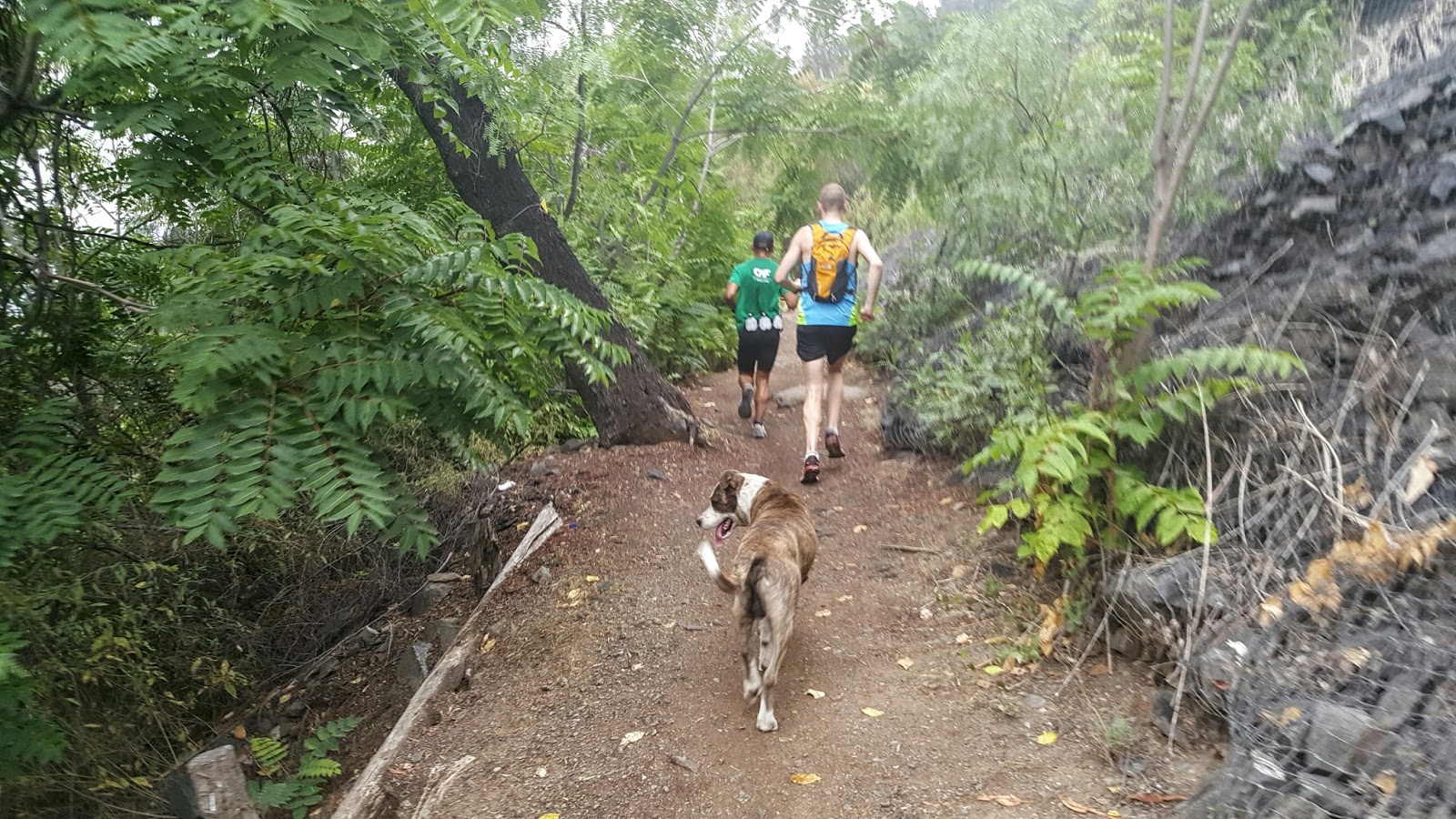
Though Santiago is a large and sprawling metropolis, it has an impressive parks system with paved and crushed cinder paths for running. As we made our way through Parque Forestal - the park system that runs parallel to the river through the city in the posh Providencia neighbourhood - we spotted a pack of runners up ahead. Mindy chased them for social reasons...it's possible I had a competitive urge to catch them as well! We followed them to the base of San Cristobal Hill, an 830 metre climb in the middle of Santiago. Immediately, they welcomed us to join them (and a few random stray dogs) on their run.


The paved route passed a zoo, and then we followed our new Team Mora friends onto the dirt trails. (Past a sign that read "Do Not Enter - Danger".


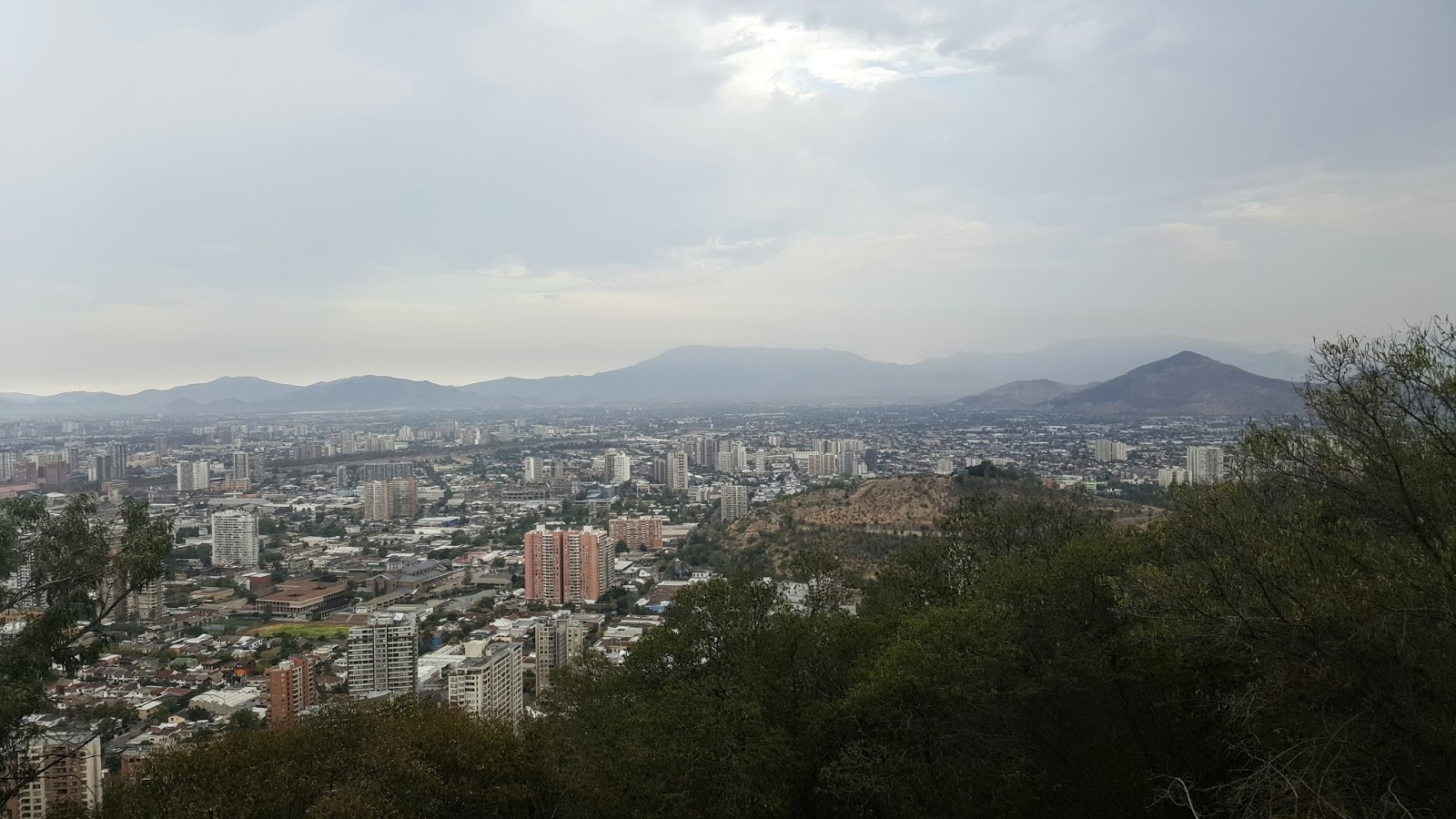
The views of the city, with the Andes in the background, were spectacular! (And afforded us ample opportunity to catch our collective breath from the steep trails.)


The peak of San Cristobal Hill is a massive outdoor church, with a church in homage to the Virgin Mary at the top.


A more traditional church also sits near the top.


The running crew gathered for a photo near the peak, unusually quiet at this early hour (as we later learned).


I had little difficulty keeping up with the group as we climbed, so I was not worried when a Belgian couple asked if I could show them a trail route down the hill. They were slower than Team Mora's runners, but I can catch up, and I remember the route...except I almost didn't. I nearly took this Belgian couple down the road route, turning back a few steps past the hidden trail entrance. Phew! 

Having set the Belgians on the right track, I started racing down the switchbacks to catch up to my crew (including Mindy). A few turns later....I still didn't see anyone. I should have found someone by now...? I asked someone if he spoke English; when he said he spoke a little, I asked whether he had seen runners come down the hill ahead of me. His face lighted up as he said "Yes, this way to run down the hill". I felt relief for a moment, until I thought about what he had said. Maybe he thought I was asking whether this route was good for running down the hill? I stopped the next group of people and asked whether any of them spoke English. One of them confidently (and fluently) replied that she did.  "Did you see a group of runners come down this way a few moments ago?" I asked. "How big a group?" she probed. When I explained it was at least 8-10 people, she assured me that she hadn't seen any.

Huh.

Um.....

I had a cell phone with a map, my wallet, and a good idea how to get back to the hotel. While I was confident Mindy would find her way, she had made it clear that she was relying on me for directions as we headed out. I pulled out my phone in case one of the other runners with Mindy tried calling, then turned around and raced back up the (steep) hill. How many routes down San Cristobal are there? I wondered....

Quickly enough, I saw Mindy running down the hill toward me, accompanied by Raul, the head coach of Team Mora, (I later learned that Mindy said she would find me herself, but Raul had none of that and generously insisted he would help.) Grateful and relieved to have been found, Raul led us on a shortcut to catch back up with his group. It was only then that we learned from Raul that the loop for today was 20+ km, including several more climbs and trails. Wow. I didn't expect that when we headed out from the hotel this morning!

Sure enough, we found Team Mora and rejoined the group as Raul led us into more dirt trails along the steep edges of San Cristobal Hill. To avoid any risk of getting lost again, I split my time between two of the stronger (and English-speaking) runners in the group - Gustavo and Anders. Gustavo, an engineer, talked about wanting to come work in Canada, but he has to work on his English first. While his English is very good, I can see that technical jargon may prove a new challenge. Through Gustavo I also learned about the impressive resume of Raul, our fearless leader: 28:50 for 10k, and 2:20 for the marathon. Damn! That is seriously good!

At the bottom of the hill with Anders, Gustavo, Carolina, and Mindy again!

We ran Team Mora back to the park where they start their runs, and gave a round of high-fives as each runner finished (in classic Chilean fashion, lots of air kisses were shared to say good-bye, but I was spared those sweaty kisses). Then Mindy and I slowly jogged back to Quiral Hotel Boutique, from where we had set out three hours earlier. Though breakfast had ended long before, we found one table set for us and breakfast set aside, as they hadn't seen us eat. So thoughtful!

We spent our afternoon lazing around in the beautiful hotel garden and wandering the streets of Santiago, checking out various markets and vendors. 


At a Canadian dinner time, we lined up at Galindo restaurant - the highly recommended spot for traditional Chilean food - for dinner. Sizing up the line, Mindy asked the gentleman in front of us whether there was anywhere else nearby that could offer similar fare. Though we were in one of the restaurant districts in Santiago, he said "No, not this good."

Looking for the vegetarian options in a restaurant that specializes in the traditional food of a meat-centered cuisine is limiting. We found the two options and ordered one of each: a humitas dish, similar to what we had yesterday with Gabriela, and a bean stew. 


I was tempted by the traditional Chilean desserts, but having had ice cream on the walk to the restaurant, I passed on more sugar. As it is, ice cream is practically a Chilean specialty now, with the way they love it!

Saturday, February 25, 2017

Santiago in Santiago

The Santiago Free Walking Tour meets in the Plaza de Armas every morning. As we have become such fans of these tours where the guides really work for their income every day, that's where we found ourselves this morning. (Thankfully, the Santiago subway system is pretty easy to navigate.)


Naturally, as one of the participants identified himself from Canada, we drew him into conversation. He's from Toronto? He works at TIFF? He's close with a friend of mine who also works at TIFF. Small world! That's how we met the man Santiago in Santiago, Chile. Not only did he provide good company on the tour and some recommendations on where to eat in Santiago, we swapped contacts so that we can connect back home, as well.

The main square of Santiago, Plaza de Armas is busy at all hours with assorted vendors, street performers, and Chileans looking for a place to sit and take in their city. Through the tour, we made our way through these crowds to observe the statues at either corner or the square. The first commemorates the Spanish conquest of Chile, and the formation of this country.


For the bulk of Santiago's history, this statue stood alone as the preeminent memorial in the square. Not surprisingly, this didn't sit very well with the native populations that had lived here before the Spaniards arrived. Recently, the city sought to balance this one-sided view into history by installing a statue commemorating the native populations on the opposing corner.


Intended to show the balance of Chilean history, this statue ultimately aggravated the issue. The native groups lobbying for recognition claim that this statue fails to represent any one of the populations that predated the Spanish; in trying to represent all of them, it represents none of them.

Our tour guide Leon was very knowledgeable about the city and introduced us to various interesting elements of Santiago. Key to his tour were two story-lines: politics, and the city's shadowy side.

The story of Allende - the first and thus far only freely elected Marxist president - and the violent shift of power from Allende to Pinochet continues to impact Chilean society today. (For his part, Pinochet is one of the very few military dictators who continues to have supporters even now, long after his reign is over.) Allende campaigned on a promise to abolish the feudal-like system that continued to exist in Chile as recently as the mid-twentieth century. Once in power, he took steps to implement this vision within the constraints of the existing constitution and legislation. Not only did this cultivate opposition from the right-leaning elements of society, it also bred antagonisms within Allende's own party, among those who felt rebellion was the only sure way to implement Marxist socialism. The growing chasm among members of Allende's own party and his policies left him vulnerable. When Pinochet decided to seize power, he did so with significant support from Chileans - largely the financial elite and wealthy classes, though also the middle class who opposed what they perceived as Allende's attacks on their opportunities to move up in the world. Pinochet countered Allende's efforts and privatised every industry - healthcare, water supply, mining, transportation - and changed the constitution to support the increased concentration of power and wealth at the top. Pinochet maintained support through his 17-year reign such that he was never really removed from power. He "retired" from the presidency to a senatorial position, and his followers continue to yield significant influence today. This ongoing support challenges the current government's efforts to open up the economy and opportunities to spread Chilean wealth more broadly among its citizens.


While political battles continue, the violence in politics is no longer (or not currently) a facet of Chile's political sphere. The changing of the guard is a ceremonial affair meant to entertain, which it did.


Leaving the polished buildings around the presidential palace, Leon showed us an uninspiring coffee shop a street or two over.


Cafe Haiti, set among banking offices, political power houses, and museums, provides the men of Santiago (and women, should they please) an opportunity to get coffee, served by a scantily clad server. A "Hooters" for coffee, if you will. This unusual business model hints at the real "coffee with legs" in Santiago, where the women aren't scantily clad - they wear nothing at all. And the coffee is merely a cover for prostitution. Mindy and I stumbled upon one of these shops on our own. The photo generated quite the stir from the person sitting outside the door, so forgive me for not taking another one for clarity.


Continuing on the tour, we walked by the source of most of Chile's drinking water:


Leon assured us that the water is muddy from the silt picked up in the Andes, but in terms of bacteria, the water is very clean. Also, Santiago has very high water purification standards. (Mindy and I pretty much stuck to bottled water, nonetheless.)

Santiago is rife with parks, which themselves have statues throughout them. Many of these are not meaningful; in an effort to beautify their parks, the city of Santiago purchased a number of statues from artists in Europe and scattered them about. The parks are beautiful!


The German gift of a fountain to commemorate Chile bicentennial does have meaning. Even after its declaration as a country, the south of Chile largely remained wild - the home of native populations who repelled initial efforts to colonize this region. Chile sought support from German immigrants to settle and "improve the Chilean race". (Leon is dark-skinned, and so pointed out with humour that this effort to lighten Chilean's complexion was not entirely successful.)


At the end of the walking tour, we found our luxurious lodgings for the night - Quiral Boutique Hotel. Set in the upscale Providencia neighbourhood in Santiago, Quiral is a beautiful hotel with the friendliest staff - highly unusual for us, we ultimately stayed there three nights!


We only had a moment to drop our bags at Quiral before Gabriela arrived to pick us up for the afternoon. Gabriela is the Chilean-born mother of our (mostly Mindy's) friend Patrick, who generously offered to show us around Santiago where she lives. It was wonderful to have this sense of familiarity after a week of traveling. The kind and wonderful Gabriela picked us up at Quiral and took us back to her apartment at first. She offered us her spare bedroom if we needed it, and assured us that she was available anytime if we needed anything. (Had Quiral not been as nice, we might have taken her up on the bedroom option!)

Gabriela then took us to meet her sister in-law Maria Teresa, who lives in a beautiful house in a residential neighbourhood. Maria Teresa's late husband loved banana trees, and so she keeps some growing in her yard!


Maria Teresa treated us to coffee and the flan (sweet milk and egg pudding) that seems to be a common Chilean dessert.

It was far too early for dinner - Chileans have dinner starting around 9pm or so - so we went out for a late lunch (it was around 6pm). Gabriela generously treated us to traditional Chilean humitas (a sweet corn dish) on the condition that we treat her when she comes to Ajax in the fall. Absolutely!


Before settling in for the evening at Quiral, we went out for a short run.


Those street signs caught my attention!

Our run finished at the beautiful Aviation fountain park, where couples seem to all congregate to bask in the coloured lights. It's such a pretty setting; we saw two couples taking wedding photos!

Friday, February 24, 2017

Punted to the West Coast

As Phil Collins might say: “Another day in paradise”! (But without the irony.) The sun is shining and Punta del Este, this blight on the “real Uruguay” (according to our tour guide yesterday), is calling to us in its idyllic appeal. Our last run in Punta – at least on this trip – had a singe objective: to get to La Mano.


Maybe Mindy had another objective...


...thankfully we didn't have a ticket for this dog to join us in Chile!

Apparently there are a couple more of these hand sculptures throughout Chile – in the Atacama Desert and Magallanes in the south. This is the only one we’ll be seeing this time around. Sometimes, kindly passers-by aren’t well-positioned to make the most of our one and only hand interaction:


Oh, well!

We desperately wanted to spend at least a few minutes frolicking in the Atlantic surf before leaving Punta, but first was breakfast. It seems that every hotel in South America offers an extensive breakfast as part of the room rate. Having dined on breads, cheeses and fruit, we set out to find a new beach in the one direction we hadn’t yet explored from our hotel. In this peninsula of endless beaches, we managed to pick the one direction that didn’t have a beach!


We opted against the rocky outcropping and meandered around the coast to the beach. We found plenty of things to make the walk worthwhile, including a tribute to the patron saint of Punta del Este.


Then it was time for fun in the waves crashing up on the shore!


Alas, we only had a few minutes to take advantage of the beach before setting out across the continent. 


We caught a bus from Punta del Este and found ourselves at the Montevideo airport once again, excited about this next leg of the journey, but sorry to be leaving this amazing destination. We debated where we would want a home in Uruguay: the history-steeped cultural centre in Montevideo, or the beachfront paradise Punta del Este. We didn’t explore enough to require a decision, though we did manage to find an American-Uruguayan who had one foot in an Uruguayan retirement, and encouraged that we consider it further. Had we sampled more Uruguayan wine in the airport, perhaps we would be looking over a deed right now….. 

This is the only country (I am aware of) where the government incentivizes the use of credit cards by eliminating sales tax (on purchases made with credit cards). That would offset living costs nicely, come retirement time. Hopefully that’s not a short-lived policy!

Ultimately it was time to board our plane to Santiago and say farewell to the land of friendly, welcoming people – who always carry mate (even in a McDonald’s):


We also had to sit through another obligatory pesticide service inside the plane...


We landed in Santiago in the late evening and took a taxi to our hotel – a nondescript, uninspiring place. The man at reception was friendly, and the room was clean (mostly). The bed was comfortable enough, and we fell right to sleep.