Pages

Monday, April 21, 2014

Day 13: “Peace in our time”

Let me emphasise that – “peace in OUR time”.  Specifically, for certain countries in Western Europe and beyond the oceans.  The appeasement strategy in the time leading up to World War Two paved the way for atrocities in Czechoslovakia.  Tijo Knoll, another Sandeman’s guide, taught us of one of these in particular today: Terezin. (Tijo is not a local Czech.  However, whatever he may lack in personal perspective for this tour is compensated by his professional area of expertise: Psychology.  A very interesting person to guide us through a former concentration camp!)

Terezin was originally a fortress town built in the late 1700s as a defensive structure for the Austrian Empire.  Though built to be impenetrable according to the military standards of the day, Terezin was obsolete shortly after it was built – the result of the dramatic changes in warfare.  Though no longer useful as a defensive fort, Terezin was nevertheless used as a garrison for approximately three thousand soldiers, as well as a prison for the likes of Gavrilo Princip (who assassinated the Archduke Franz Ferdinand, providing the most proximate cause for the start of World War One).  The town of Terezin – inside the fort – included an additional two thousand civilians. When the Nazis occupied Czechoslovakia, they turned Terezin into a concentration camp for Jews from Czechoslovakia, Denmark, the Netherlands…from wherever it was convenient.

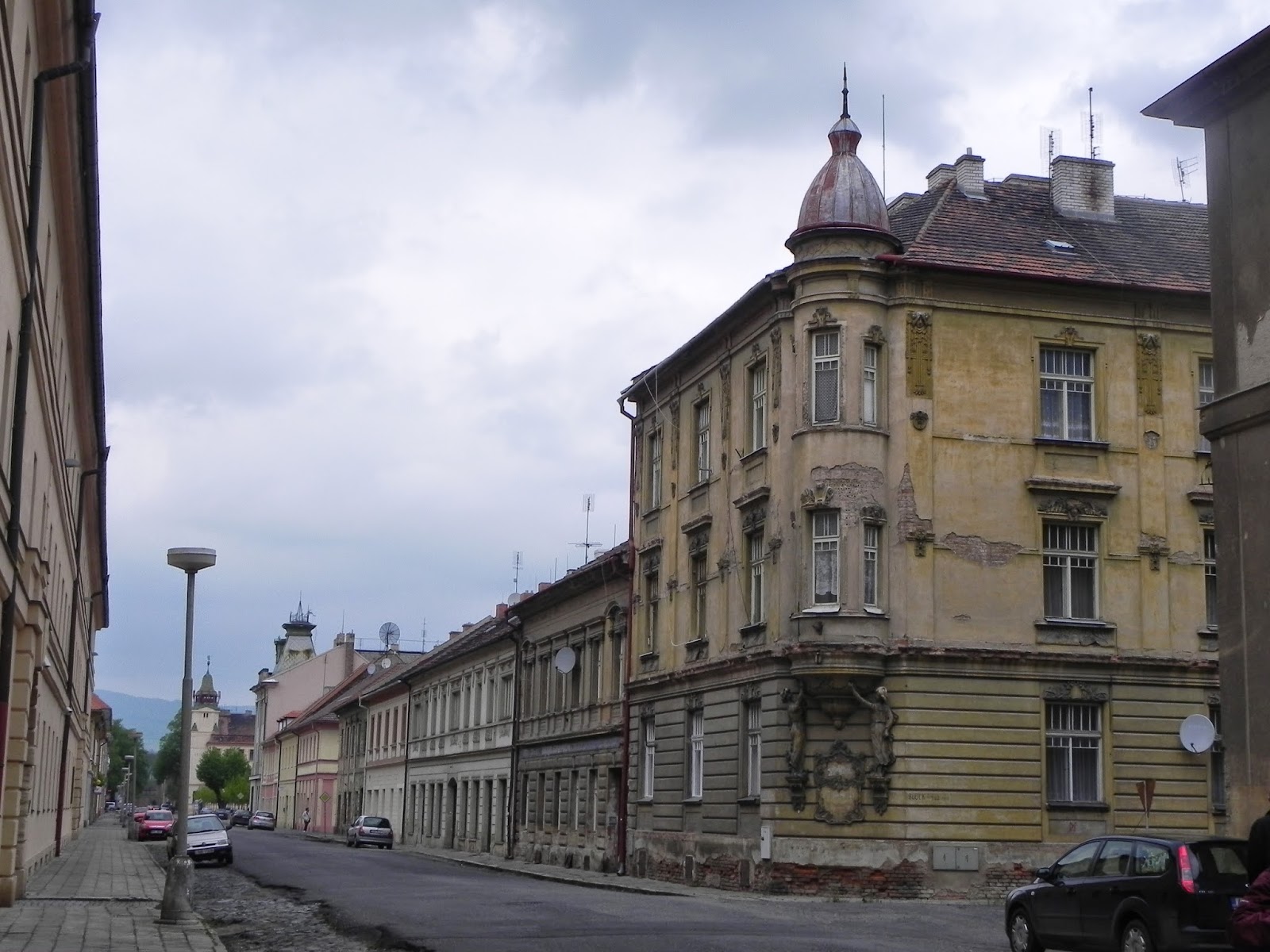
Today, Terezin once again houses some two thousand civilians, but the garrison is gone.  With no military infrastructure, the town lacks investment, economic opportunities, and purpose.  The decay is evident where resources are simply insufficient to maintain the crumbling buildings.  However, for the people who live there, it is still home.


Apparently natural, these giant rats that congregate around the streams in the old fort moat.  These things are the size of small dogs!

Our trip to Terezin, although under incomparable circumstances, followed the path of the Jews who were forced there.  We disembarked from the main train station and walked the mile or so to the fort.  In time, the Nazis extended the railway right into the fort itself.  This was not an act of generosity toward the Jews; the Nazis simply did not want the locals to see what was going on.  (With respect to the circumstances…the very first Jews transported to Terezin were older people who had been “sold” a retirement residence in the picturesque setting of Terezin.  They sold their properties, packed their belongings, and arrived expecting a quiet and peaceful life.  Their shock began when they were told they had to walk, carrying all of their belongings, from the station to the fort.) Though I knew what I was getting into, I couldn’t help but notice the serene surroundings; naturally beautiful landscapes and birds singing.  It is strangely juxtaposed against what took place there less than a lifetime ago.
I don't normally get too caught up with my own photography, but I love this photo.  This is where the tracks end just inside the gates to Terezin.  This Jewish man was on our tour; relatives of his had faced the concentration camps in World War Two. The symbolism really gets me.

According to Nazi propaganda, Terezin was a town that was “gifted to the Jews”.  A place they could call their own.  This gross distortion of the truth was validated by the Red Cross when they examined the camp to ensure it was fit.  Somehow, the rest of the world was satisfied that forcibly moving people from their homes and relocating them to a confined camp was acceptable, provided that this prison included a used clothing store (where the prisoners could purchase their own clothes that had previously been confiscated) and had its own Jewish money. (The bank notes had the face of Moses.  The original graphics were changed by the Nazi authorities to make the faces more “Jewish”; Moses’ nose was made longer and more crooked.) Ingrained anti-Semitism may have been the immediate cause for this acceptance, though we didn’t do much better in the face of Rwanda.  Perhaps most cruel for the purposes of propaganda was the fact that Jewish prisoners were filmed tending vegetable gardens for the rest of the world to see.  Though the gardeners smiled and laughed as they weeded and hoed, they were never to enjoy the fruits of this labour.  Those vegetable gardens were to feed the Nazi SS.

The propaganda was that Terezin was a Jewish idyll.  The reality is that this fort, made to house seven thousand people, reached a peak population of 58 000 prisoners.  Death was a reality every day, not only due to horrific abuse at the hands of the guards, but also to over-crowding and a lack of the basic necessities of life.  
As per Jewish custom, those who died in the early days at Terezin were buried in coffins made of wood. 

In time, as the death rate increased, mass graves were implemented and coffins were deemed superfluous; burial sites were identified only by the approximate placement within a grid outline. 


Finally, as even this system was overwhelmed, a crematorium was built.  The crematorium had a capacity for up to 180 bodies per day. 

In the end, over 20 000 bodies are buried in the graves around Terezin.

Conservative Jews are opposed to cremation, as they believe their bodies are to be buried in the ground – untouched – after death.  Consequently, it was a new horror not only for these Jews to face cremation at Terezin, but also for the Jewish inmates to have to build and operate the crematorium, themselves. Further, upon direction from the Nazi SS, the Jewish workers of the crematorium had to sift through the ashes of the bodies to ensure that gold fillings and such were retrieved before the ashes were disposed.

I should clarify something when I keep referring to the Jews at Terezin.  The peculiarities of the Nazi definition of Jewish meant that there was a substantial population of non-Jewish (according to self-identification) prisoners in Terezin.  The Nazis deemed that anyone with three out of four grandparents identified as Jewish was also Jewish, irrespective of practice, belief, or self-identification.  Think about that.  People who were several generations away from practicing Judaism could be sent to Terezin simply because of the cascading effect of this “three out of four” principle.  As a result, Terezin not only hosted a majority Jewish population, but it also imprisoned Christians, Atheists…and anyone else who had the misfortune to be sent there.

Wandering through the cemetery outside of Terezin is a reminder of what atrocities one human can inflict upon another; however, our guide Tijo ensured that the theme of the day remained that some good exists in even the most terrible circumstances. (There’s that Psychology training coming through…)  To one side in the Terezin cemetery, there stands a memorial crowned with the Soviet hammer and sickle.  The Soviets reached Terezin during a mass outbreak of infectious disease.  To avoid worsening the reach of this outbreak, the Soviets quarantined the camp, releasing only those prisoners who were given a clean bill of health.  Soviets clinicians tended to the sick and dying in Terezin, knowing that the outbreak was deadly.  This memorial is dedicated to those Soviet clinicians who died while tending to the sick prisoners at Terezin.

Bad as things were at Terezin – and they were horrific – conditions were better than some other camps.  Terezin was the “model camp” used for Nazi propaganda purposes.  Though a prisoner might be beaten to death for breaking some trivial rule such as throwing paper on the ground, the inmates as a whole were granted a modicum of self-governance through the establishment of a Jewish Council.  This council allowed for the development of an artistic culture at Terezin – primarily theatre, though also some clandestine art.  A few of the pieces of theatre have survived the camp and the war.  Some of the art that survives provides an honest glimpse into the terrors of Terezin.  That there was such an artistic scene indicates a glimmer of hope. It's tough to say whether the hope was warranted.

This was one of two billboards of children's artwork on display in Terezin.  This one had the higher survival rate of the two. Only six of the seven children whose art is displayed here died in Auschwitz.

This is but one section of a heartbreaking series of walls listing all the children who died in the concentration camps.

Even though several members of the governing council met their ends in Auschwitz or elsewhere at the hands of Nazis, members of this council were criticized after the war for their collusion with the Nazi oppressors. In their defense, the council had the nearly impossible balancing act to manage of minimizing the atrocities of the camp, while providing a subdued and cheap labour force.  Jewish prisoners at Terezin were worth more to the Nazis alive than dead provided the camp was a source of slave labour.  Consequently, the inmate of Terezin did everything from mending Nazi uniforms, to sort belongings confiscated from other Jews, to rudimentary manufacturing.  All of this was in addition, of course, to the creation of basic infrastructure for the town (waterworks, sewage, etc.). 

Due to overcrowding and lack of sanitation, bed-lice were a constant at Terezin.  Some inmates were tasked with de-lousing mattresses using a pesticide on the outskirts of camp.  This pesticide was the same chemical used in the gas chambers in the death camps. A most troubling and cruel parallel reflecting the Nazi perspective on Jews.

This exploration of the concentration camp at Terezin made for a somber day.  At one point, I overheard Tijo comment that he actively avoided conducting this tour more than once per week, lest the connection become disjointed; the delivery become too clinical.  Whatever he was doing, it was working.  He provided a balance between the honest realities of the horrors of the camp, and the single candlelight that can chase away the most complete darkness.  Then….there was once that it wasn’t Tijo who injected levity into the day. As the tour walked slowly back to the train station after departing Terezin, a motorcyclist came motoring down the road toward us.  I then witnessed what I have never seen outside of TV or the movies: the driver popped a “wheelie” and maintained it for at least a hundred metres beside us.

Tijo had one more stop for us before sending us back to our own lives in Prague.  In case the motorcyclist’s antics weren’t enough, Tijo had one final message of hope to counter the heavy content of the day.  Back at Prague train station, we stopped at platform number one.

Nicholas Winton found himself at a Jewish refugee camp in Czechoslovakia just before war broke out in 1939. He was troubled by the number of women who attempted to press their babies upon him to take with him back to England.  Touched by their effort to give their children a better life – any better life – Nicholas Winton proceeded to arrange for the adoption of 669 mostly Jewish babies from Czechoslovakia refugee camps to English families in the first eight months of 1939.  Given the odds of babies in these refugee camps, the “British Schindler” most definitely saved their lives.

What do you do after a day like that?  I thanked Tijo for an incredible, emotional and memorable exploration into the concentration camp at Terezin, and life in Czechoslovakia during the war.  Then I made my way back to my hotel, had a quiet dinner, and wandered down to the Vltava River.


Sunday, April 20, 2014

Day 12: Czech it Out!

Sleeping on a bus is…..efficient.  I’ll leave it at that.  Arriving in Prague does an awful lot to make up for a lack of sleep!  Actually, like Luxemburg, the Prague bus station is in a bit of a run-down part of town.  A short walk, however, brings you to the Powder Tower; originally, a part of the walls encircling Prague.  As the fortified area expanded, the Powder Tower became storage for gunpowder.

After dropping my bag at the front desk of my hotel (it was 7am, so I couldn’t exactly check in yet), I saw the old city in rare form:


Deserted! I didn’t know it at the time, but the main tourist areas like Old Town Square, Charles Bridge, and Wenceslas Square are packed through the middle of the day!


Quite the Easter fans!

Jan Hus was possibly the first protestant within the Catholic Church.  He was burned alive for his protests.

To reconnoitre myself in Prague (and to take advantage of what time I had left before the inevitable crash this afternoon), I booked a tour this morning.  You guessed it!  Sandeman’s Free Walking Tours.  
(Unfortunately, this is my last Sandeman’s Free Tour on this trip, as they don’t have a presence anywhere else that I am going.) The group of us met our guide Martin in Old Town Square by the Astronomical Clock. Martin is a Prague boy – born and raised – and an architecture major to boot.  Could there be a better combination for a guide in Prague??!!  The buildings framing Old Town Square span eight hundred years of architectural history, from the gothic Church of Our Lady before Tyn (c. 12th century) to the early twentieth century examples alongside. The Church of Our Lady before Tyn is an interesting piece – it was expanded and expanded to the point that it is right against other buildings.  The only cathedral I’m aware of that you can’t see its front façade.


The massive, Catholic Church of Our Lady before Tyn looks across the square at the massive, Catholic (Baroque architecture) St Nicholas Church – just a few hundred metres away. 

(Actually, St. Nicholas Church has been a Protestant church for the last ninety years or so…but it was built as a Catholic church…and let’s face it, they’re more or less the same.)   Prague has more churches per capita than just about anywhere else in the world.  The irony?  After forty years of religion-suppressing communism, 70% of Czechs identify themselves as agnostic or atheist.  Most churches in Prague are used for something other than church services – concert halls, museums, or in the most extreme example, a strip club! (What's that line from a Nine Inch Nails song...."you bring me closer to God"?)

This preponderance of churches provides visitors with breathtaking views of the City of a Thousand Spires, and beautiful architecture down every street in the city.  However, Prague is also home to what has been voted the most disappointing attraction – the Astronomical Clock.

With a bit of context, the clock really is fascinating…but you won’t know that just by gathering with the hordes to watch it chime in each hour. Three of the four characters on either side of the clock face represent human frailties: the man looking in the mirror demonstrates narcissism (no comment), the man with the instrument shows earthly pleasures, and the man with the bag of money represents avarice.  As the clock begins to chime in each hour, these men shake their heads “no”, as in – “I don’t want time to pass and bring me closer to death”.  The fourth character is death – embodied (or…um…not…) by the skeleton. When the clock chimes, the skeleton nods “yes” as he brings people one hour closer to his grasp. The shuttered windows above fly open and the Apostles look down on human weakness.  Finally, in conclusion, the rooster flaps his wings and crows to remind sinners that tomorrow is a new day; a new chance to turn one’s life toward the good. The clock face itself tells time according to both Roman time and Old Czech Time – hours in the day and hours since the last sunset.  Further, the sun on the face of the clock gets closer to or farther from the rings of numbers in accordance with its height over the horizon. Pretty damn impressive if you consider that this was all built in the fifteenth century!!

Prague came to prominence in the middle ages largely thanks to Charles Bridge.  Sort of.  There’s a big river, and few places to cross it.  Charles Bridge, which was built in 1357 (May 3rd, at 1am, making it a perfect numeric palindrome), replaced an earlier bridge which was washed away in a flood.  That bridge was a mere 200 years old, having also been built to replace an earlier bridge that washed away in a flood.  (Apparently Charles’ astrologers, who came up with the time and date to lay the foundation stone, were right.)  In any case, these bridges established economies in and around the river crossing as merchants carried goods beyond the Vltava river.  The bridge is decorated with a seemingly endless stream of statues, and – at 7:30am as I wandered across – a seemingly endless stream of Asian brides taking wedding photos. These brides were being realistic.  By mid-day, the bridge was a heavy crowd of tourists!

The custom of "love locks" is alive and well at the Charles Bridge.

Wenceslas Square which – according to Martin: “…is a rectangle, but we call it a square anyway, because that’s how Czechs do things” didn’t make it too high on my list of things to do in Prague.  It’s a shopping headquarters, and it’s home to two Starbucks (of the four that are in Prague), but the most interesting bits for me were the National Museum and the statue at the end.


Given the name of this place, you might have guessed that’s St. Wenceslas (or King Wenceslas, depending on when in history) on the horse. (You can kind of see it in the foregr4ound of the first photo.) I guess with my trekking from Luxembourg to here, I haven’t left his old stomping grounds!

The Czechs say that beer was invented in Bohemia…and while the concept of beer pre-dates Bohemia, they’re kind of right.  It was here that the pilsner was born – the difference between top and bottom fermenting of the drink, which produces the clear, light drink of such wonderful tastiness! (Ok, so the truth is I still don’t like beer, but I did find some worth drinking…or at least tasting…while I was here in beer-land.)  One of these was the unfiltered variety of Gambrinus.

Maybe it was the beer; more likely, it was the quality tour and the promise of Prague!  In any case, I bought a couple more tours of Prague while I was drinking – Terezin the concentration camp tomorrow, and Prague Castle the following day.  I’m transforming into a total tourist nerd!

I suppose it’s better than transforming into a big potato bug, which is more or less what Kafka writes about in the one and only Kafka story I’ve read.  He’s a celebrated hero in Prague, and the (so I am told) persistent theme in his works of transformation and loss of identity make a little more sense when one learns that he lived through the disintegration of the Jewish Quarter in Prague.

It wasn’t a terrible thing, really, that Jews were suddenly allowed to live outside of the Jewish Quarter, but it occasioned a shift in the Jewish ghetto (in the original, and not exactly negative sense of the word) from an excessively over-crowded place that at least retained a sense of community, to the most derelict neighbourhood occupied by students, squatters, and those Jews who lacked the wherewithal to go anywhere better.

After the earlier education in Christian architecture over the ages in Old Town Square, our tour into Prague’s Jewish Quarter examined architecture from another side of Prague’s religious development.  This temporary synagogue was built starting in 1270.  “Temporary”?  Indeed.  The Old New Synagogue includes stones from the original Temple in Jerusalem, and so these stones will one day be returned to Jerusalem when the Messiah comes.  Such poor planning.  Why build a structure that will only last for a eight-hundred or so years?  (Alternatively, one might ask whether the Jews are still quite as hopeful about this Messiah…)

Across from this synagogue lies the old Jewish cemetery.  When Jews were confined (by curfew!) to the Jewish Quarter, their cemetery had to be there, too.  As the Jewish population increased, and the cemetery filled, there was nowhere to build but up.  Apparently the cemetery is as many as twelve layers deep!  Eventually, when the restriction on Jewish housing was lifted, it was also recognized that it is very poor planning to have a mass of rotting corpses in the middle of a crowded city.  The new Jewish cemetery was moved to…what is now right within the city.  I guess at the time it seemed a long way out.

There's a certain natural platform that overlooks the city of Prague.  In homage to the Czech musical tradition, there's a giant metronome set up - symbolising the changing fortunes of this city over the last thousand years or so.  Previously, a giant statue of Stalin was up there...keeping a close watch over everything. (Stalin never actually saw this giant statue, but it would have been creepy to see it as a Czech, nonetheless.)  Between Stalin and the metronome?  A giant statue of Michael Jackson.  Equally creepy!

I was excited that this tour was being led by a local, even though most of the information could easily have been delivered by anyone with the right information and proper poise.  Every so often, though, Martin would insert something that reminded me why I was so happy to be toured by a local. 

Martin’s parents and uncle swapped spots in a two-day long line-up to get a car just like that.  It was excessively expensive.  It was slow, unreliable, and noisy. (It has a two-stroke engine…like my lawnmower.  I think – quite honestly – that the horsepower is about the same as my lawnmower, too.)  Nevertheless, it was a car, and there weren’t many car options in Soviet-era Prague.

This is where I saw a Czech string quintet perform Dvorak!

This is also where we sat on the steps of the Rudolphinum as Martin told us that his father had been a classmate of Jan Palach. A university student at Charles University, Jan Palach was just 21 years old when he burned himself to death to protest the Soviet invasion of what was then Czechoslovakia.  Martin proceeded to detail for us the interesting mix of Czech opinions of the Soviet experiment.  Martin’s father was against communism, and exiled himself to Western Europe until the Czech borders were being “permanently” closed.  Martin’s mother, conversely, was supportive of communism…until the full force of communism set in and the gap between the propaganda and the reality was revealed. Although he was raised in Prague, Martin spent a year living in the U.S. as he was growing up, when his father took a job at an American university.  When they moved back, Martin faced culture shock moving back to his home.  The silver lining?  He started correcting the English teacher at school!

It’s Easter Sunday, and while I am missing a dinner with my family back home, I wanted to make this evening stand out.  I went to see a concert featuring the Czech composer Dvorak, which was fantastic.  True to its original intent as a cultural building, the setting for this concert was the Rudolphinum.  This building has also served as the House of Commons and a Nazi headquarters.  Like so many buildings in Prague, the size and beauty of the architecture are mind-boggling.  Of course, a quick glance across the river shows the massive Prague Castle towering over everything else.  What a backdrop!


Easter dinner was a traditional Czech goulash with dumplings, more dumplings for dessert, and a digestif of absinth. I may see the Easter Bunny tonight!

Day 11: The Old Kingdom

It’s rather confusing that Luxembourg even exists.  It’s a small country sandwiched among substantial powers that has little economic raison d’être.  Nevertheless, the duchy of Luxembourg has been around since the ninth century.

I had great plans to be up and about at seven this morning to make the most of my one day in Lux.  When the alarm went off, I recalled that my “hotel” tonight is a bus, so maybe sleeping in and enjoying a king-sized bed this morning is in order.  Eventually, I got my stuff together and headed toward the old city.

For a small city, Luxembourg has a pretty extensive and picturesque park network.  And the playground!!  A ship?  Look at the height of that slide tunnel!


Emerging from the park and entering the old city…it felt a bit like walking through Yorkville.  Lots of the same stores and a similar “posh” feel.

Ok, not ALL of the stores are like Yorkville…

After a few more turns, I was in the Place d’Armes, strolling through a…flea market.  Lots of vendors selling odd assortments of tchotchkes and junk, including cassette tapes!  (Maybe some of those vendors think that Lux is still in the ninth century!)  It made for interesting wandering, anyway.  Then I found my way into the food market.  This is more my style!  I got some delicious marzipan pastries, and the Ferrari of cheeses! (I have no idea what it’s called other than that, but it is old, pungent, and covered in squashed grapes…..and wonderfully tasty!) The food market is in Place Guillaume II, so named after the guy on the horse in the statue – Grand Duke William II.


The Grand Ducal Palace sits at one end of Place Guillaume.

So…you enlist in the Luxembourg military.  You complete your training, do whatever advanced training is necessary, and then you’re stationed at the Duke’s Palace.  Is this a testament to your quality – a job that fills you with pride?  Or is it a “don’t-look-at-your-watch-don’t-look-at-your-watch-don’t-look-at-your-watch…Damn!  It’s only been three minutes.” kind of job? As Luxembourg is a neutral country by treaty, I suppose one could hope that there wouldn’t be frequent plots against the Duke.

A European Union information office sat across from the palace.  Because I’m a big nerd, I went in and picked up some more pamphlets about the EU’s role.  I also learned there that Lux was one of the founding countries in the EU (recall that thought the other day about small countries preferring multilateralism?), and that – like Belgium – Lux has been designated as host for key EU offices, such as a number of EU courts and tribunals. (Two of these courts were right across from my hotel. There was also a banker’s training centre.  I guess there is demand for the posh hotel when it’s not Easter week-end!)  I suspect that the EU office doesn’t really get a lot of tourism traffic, as the receptionist there was exceptionally friendly, and went out of her way to find all kinds of pamphlets and documents on topics I might find interesting.

Luxemburg adores their Grand Duchess Charlotte; they named a bridge after her (more about street names later), and they adorned the (top of the) WWI memorial with a statue of her:

In WWII, the Nazis were disinterested in Luxemburg neutrality – they were coming in.  The people of Lux were afraid that the Nazis would take their beloved statue of Grand Duchess Charlotte, so they hid her by burying her in the ground.  It worked!  The Nazis never found her.  Neither did the Luxemburgers, for about forty years.  This statue was rediscovered when they were digging foundations for a new building in the eighties.

Similarly, I discovered the entrance to Luxemburg’s Casemates by accident.  This was part of the day-tour Aurelie (front desk at my hotel) had mapped out, but – I’ll admit – at that moment I was looking for the toilet.  To recap: Luxemburg is a curiosity in that it has even survived; however, its survival has been linked to its neutral status.  Neutral or not, Lux hasn’t always relied on the goodwill of its neighbours (and its remoteness).  It’s a small population base, so the Lux army is of course small.  In order to make the most of its small army, Luxemburg built a series of tunnels (casemates…rooted in the Greek word for cave) that allowed for troops to move from one portion of the defensive walls to another without being exposed to enemy fire. 


By the way, that’s a REAL cannon from the seventeenth century.  It’s slowly rusting away, but it’s being sacrificed, apparently, for historical legitimacy.

These tunnels were commenced in 1644.  Over the next two hundred years, the network of tunnels was extended and improved to culminate in 23km of tunnels that were meant to make the Luxemburg defenses impenetrable.  It was nick-named the “Gibraltar of the North”.  As it turned out, this moniker was a little off, as Luxemburg was repeatedly occupied by opposing forces.  In the end, a treaty in 1867, wherein Lux pledged neutrality, allowed Luxemburg to retain its independent status.  As part of this pledge, 6km of casemates were destroyed – key sections that allowed for troop movements from one fort to another.  Of the remaining 17km, a good chunk of it is currently used by a bank to store valuables.  Another section is used to hold generators that supply part of the electricity in Luxemburg.

In more recent years, the casemates once again played a crucial role for the safety of Luxemburgers.  In WWII, forty thousand people huddled in the casemates seeking protection from bombs.  In case the crowding and fear weren’t enough, there has never been running water in the casemates. 

The wall belongs to a bathroom stall.  The words read: “remember the sand”.  A handful of rudimentary outhouses serviced the Luxemburgers seeking refuge here.

Back to street names.  A main road through the center of the old city is F.D. Roosevelt street. My hotel was on John F. Kennedy street. John F. Kennedy becomes Robert Schuman.  That last one makes sense when you consider that Schuman was “the architect of the European Integration project” (thank-you, EU documents).  The rest?  I’m not sure why a small European country with a history spanning over a thousand years names its streets after recent American political figures.  Another curiosity of Luxemburg.

I spent the later part of my afternoon wandering through the lower town (the Grund) and exploring the old fortifications.  I was following the “Wenzel route” – named after Wenceslas.  Strange.  Wenceslas played a significant role in the history of Prague…


Perplexing. I guess those ancient ruins don't re-build themselves!

This view was worth every steep step back up the hill.

This was a great little stop on this adventure, but one day seems to be about right for Luxemburg.  I made my way back to the train station Saturday night to catch an overnight bus to Prague.  Nine hours, and I would wake up in another part of the continent altogether.


I can’t wait!